Week 2
This week our topic of exploration was “Role-Playing”. Connie gave us a reading but asked us to think about which artists come to mind when you think about role-playing before going through the article. This is what I came up with:
“There are many artists that could be considered to have work that reflects some kind of role-playing. In most cases, I believe this role-playing to be subtle, but there are two prominent names that pop into my head where role-playing is very obvious but very different in both artists. Cindy Sherman and Brooke Shaden.
Cindy Sherman:
Throughout her entire career she has been addressing various views regarding the female body and female identity. She has created work that is in base a critic to society, but uses herself as the subject, hence playing various roles of women. It is never really her, but it could certainly be so, it is just the way she prefers to work. Her type of photography disguises herself as the main subject and instead focuses on the entire set/environment/character she wants the public to perceive. She has a very commercial/ cinematic aesthetic which adds to the fact that these photographs could certainly be an accurate representation of the world, and not a role-playing scenario.
Brooke Shaden:
Her work is very different from Sherman’s. Brook’s approach to photography is based on a surreal aesthetic where her surroundings and even herself do not need to resemble or seem accurate scenes from this world. This is because her work is based on imaginary scenarios she dreams or thinks of, and then digitally manipulates them until she achieves a desires effect or concept. I believe that although not so obvious, her work is somewhat a part of role-playing. It’s not that she is trying to critique, and possibly the viewer will not be familiar with any role she could possibly play, but the truth is she is playing a role of a character that was made up in her mind. She is not using herself as an accurate representation of her in the world, but instead role-playing a part of her character in her imagination.”
After I read the article it was clear that I had missed a lot of what role-playing actually is. There is much more to it than just pretending to have a different identity, or even to role-play as a critique to society. Sometimes, just by pointing the camera at yourself you are immediately role-playing, because as the article suggested, there really isn’t an un-staged moment as soon as you point the camera at yourself.
This concept had me thinking a lot on how I was going to deal/approach this assignment. Up till now I believed my work to be very surreal and hence although I was in the picture, I didn’t feel the story was exactly about me, my real identity, but instead was about this character that was living in these scenes that I created. But with last weeks work my vision of a self-portrait kind of changed. The work I mad had become totally about me, who I was and who I am, and that made me think about who I should be and about real life expectations that parents, friends and family have for me. Of course I decided to go off on a tangent of what expectations were given t females back to when my parents were growing up. When women had to excel at domestic tasks, and not so much in the job industry. I opted to use black and white to have a more timeless feel, where time can kind of be forgotten and the actions themselves analyzed instead. This is what I came up with:
“REAL EXPECTATIONS”
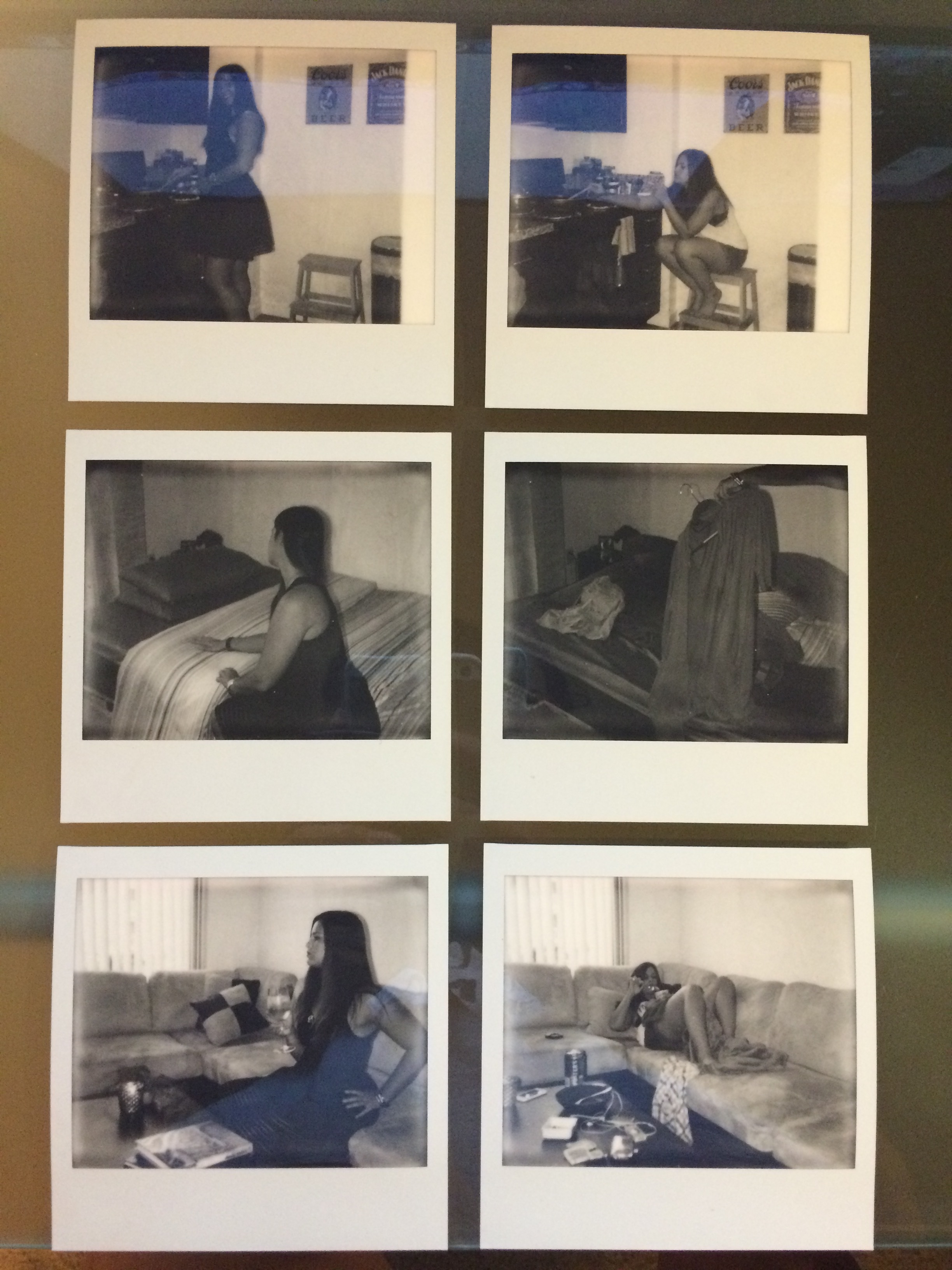
Although I quite like this set, I am not sure the quality of the Polaroid film was kind and in agreement with my overall concept. The only thing working for my idea of expectations vs. reality is the candid effect the images ended up having. I believe that in all of them I am role-playing, because it they were scenes that were carefully composed and I had to practice the poses, but the bad film quality give them a voyeuristic feeling that could actually portray as “recording” both sides of what could have been. I also showed these around to some friends, and the different interpretations that were thrown at me were overwhelming, but I think that’s what my work is about, being able to relate to different audiences by having open ended narratives.